


Building America's Domestic Source for Ultra-High-Purity Silver
Strategic Materials Refining Group (SMRG) is developing a secure, traceable, U.S.based refinery to supply ultra-high-purity silver for defense electronics, semiconductors, energy systems and advanced manufacturing.
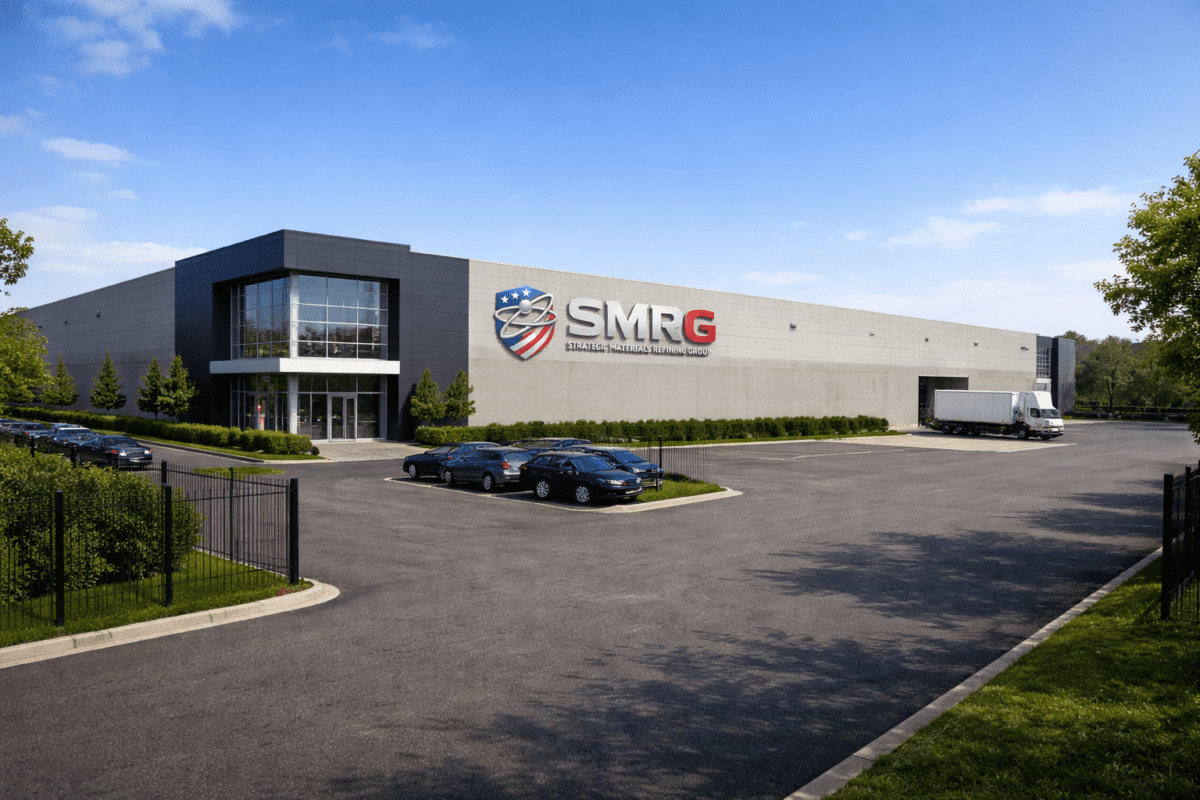
🇺🇸 A PROPOSED AMERICAN REFINERY · GREENEVILLE, EAST TENNESSEE
4N
99.99%
Electronics Grade
5N
99.999%
Nuclear Grade
6N
99.9999%
Space & Defense Grade
6N
Target Maximum Purity
99.9999% Ag
4
Critical Industries Targeted
Served Domestically
100%
Planned Domestic Production
Site secured · Greeneville, TN
3
Planned Purity Grades
4N · 5N · 6N
ABOUT SMRG
A PROPOSED STRATEGIC SILVER REFINERY FOR AMERICA
Strategic Materials Refining Group was founded on a single conviction: America’s most critical industries deserve a domestic, sovereign source of ultra-high-purity silver. SMRG has secured land in Greeneville, Tennessee, and is developing a purpose-built refinery there to serve industries where material failure is not an option. East Tennessee has a deep heritage in advanced manufacturing and sits within reach of the nation’s nuclear and defense research corridor. The proposed facility is planned to process mine doré and recycled silver into finished 4N, 5N and 6N product. Silver has the highest electrical conductivity, thermal conductivity and optical reflectivity of any metal. At ultra-high purity, those properties are maximized — making it essential for semiconductor fabrication, nuclear reactor control systems, satellite electronics and mission-critical defense platforms.
- Highest electrical conductivity of any metal
- Highest thermal conductivity of any metal
- Designed for a fully domestic supply chain
- Quality system planned to ISO 9001:2015
PLANNED PRODUCTS & SPECIFICATIONS
THREE GRADES, ENGINEERED FOR DEMANDING APPLICATIONS
SMRG is designed to produce silver at three purity levels, each targeted to the specifications of the world’s most demanding industrial applications.
4N
Ag 99.99%
Four Nines Silver
Electronics & Industrial Grade
The foundational grade for advanced electronics manufacturing. SMRG 4N silver is intended to deliver the conductivity and purity required for printed circuit board pastes, multilayer ceramic capacitors, membrane switches and high-performance electrical contacts.
TARGET APPLICATIONSvv
- PCB conductive pastes
- MLCC electrodes
- Electrical contacts & switches
- Silver brazing alloys
- Photovoltaic cell metallization
- Catalytic converters
MOST REQUESTED
5N
Ag 99.999%
Five Nines Silver
Nuclear & Advanced Industrial Grade
For applications where trace impurities can compromise safety or performance. SMRG 5N silver is being designed to meet the stringent requirements of nuclear control rod alloys, advanced semiconductor processing and precision optical systems.
TARGET APPLICATIONS
- Nuclear control rod alloys (Ag-In-Cd)
- Semiconductor sputtering targets
- Precision optical coatings
- High-purity silver wire
- Advanced brazing applications
- Medical device components
6N
Ag 99.9999%
Six Nines Silver
Space, Defense & Research Grade
The apex of silver purity, planned for applications where no compromise is possible: deepspace missions, radiation-hardened electronics, defense systems and fundamental materials research.
TARGET APPLICATIONS
- Space-grade electrical connectors
- Satellite solar array contacts
- Radiation-hardened electronics
- Defense system components
- Research & standards laboratories
- Advanced photonics
Planned product forms
Ingots
Cast to specification
Granules
Controlled particle size
Powder
Sub-micron under evaluation
Wire
Custom gauge
Foil
Ultra-thin under evaluation
Shot
Uniform spheres

PLANNED PROCESS
DESIGNED FOR PRECISION, FROM FEEDSTOCK TO PURITY
SMRG’s process is designed around Moebius electrolytic refining — the industry standard for high-purity silver. This electrochemical method achieves selectivity and purity that pyrometallurgical techniques cannot, and is the planned foundation for all three grades.
STAGE 1 — ALL GRADES: MOEBIUS ELECTROLYTIC REFINING
1. Feedstock Receipt & Assay
Incoming silver feedstock, including mine doré, industrial scrap and refined silver, will be analyzed by ICP-MS and XRF to establish baseline composition before processing.
2. Anode Casting
Feedstock will be melted and cast into precision anodes, with composition controlled to optimize electrolytic efficiency and limit impurity loads in the refining cells.
3. Moebius Electrolytic Refining
Anodes will be suspended in silver nitrate electrolyte. Controlled DC current deposits pure silver crystals on the cathode, while impurities collect as anode slimes for separate recovery.
STAGE 2 — 5N & 6N ONLY: HORIZONTAL ZONE REFINING
4. Ingot Preparation & Loading
4N silver from the Moebius cells will be cast into cylindrical ingots under argon, loaded into high-purity quartz or graphite boats, and placed in a horizontal zone-refining furnace back-filled with ultra-high-purity argon.
5. Multi-Pass Zone Refining
An induction coil will move a 2–5 cm molten zone along the ingot at 1–5 cm per hour, carrying impurities such as copper, lead, bismuth and tellurium to the trailing end. The design calls for 8–12 passes for 5N and 20 or more for 6N.
6. Impurity End Removal & Re-Casting
The impurity-rich trailing section (about 1015% of ingot length) will be cut away and returned to the Moebius feed. The purified ingot will be re-melted under argon and cast into the customer’s form inside a planned Class 100 (ISO 5) clean room.
7. 5N/6N Analytical Verification
Zone-refined silver will be verified by GDMS at subppb detection limits, cross-checked by ICP-MS, across a minimum of 72 elements. SMRG plans internal acceptance criteria stricter than the published grade specification before any Certificate of Analysis is issued.
8. Final Form Processing & Clean-Room Packaging
Certified material will be at customers request into ingots, granules, powder, wire, foil or shot and sealed in clean-room packaging to protect purity through shipment.
Zone refining, first developed by William Pfann at Bell Labs, exploits the difference in impurity solubility between solid and liquid silver. A narrow molten zone, created by an induction coil, passes slowly along a silver ingot. Because most metallic impurities have a segregation coefficient (k) below 1, they stay in the liquid and are swept to the end of the ingot with each pass. Repeated passes drive total impurities below 10 ppm for 5N and below 1 ppm for 6N.

ELECTROLYTIC SILVER CRYSTAL FORMATION
Ultra-pure silver dendrites forming on a cathode during electrolytic refining. The tree-like crystal structure is a hallmark of highpurity electrodeposition. (Representative image.)
TARGET INDUSTRIES
WHERE PURITY IS NON-NEGOTIABLE
SMRG is being built to supply four of America’s most strategically vital industries. In each, silver’s performance directly determines the reliability, safety and capability of systems that protect and power the nation.

ADVANCED ELECTRONICS
THE CONDUCTOR AT THE HEART OF EVERY CIRCUIT
Silver holds the highest electrical conductivity of any element — 106% IACS (International Annealed Copper Standard) — and the highest thermal conductivity at 429 W/m·K. These properties are not merely incremental improvements over alternatives; they represent a fundamental physical advantage that no other material can replicate.
SMRG’s planned 4N and 5N silver is aimed at conductive pastes for printed circuit boards, MLCC electrodes, membrane switches and semiconductor packaging. As device geometries shrink and power densities rise, purity matters more — trace impurities at the parts-per-million level can cause electromigration failures or degrade signal integrity.
- PCB Conductive Pastes
- Semiconductor Packaging
- RF Connectors
- MLCC Electrodes
- Membrane Switches
- Solar Cell Metallization
NUCLEAR ENERGY
CONTROLLING THE POWER OF THE ATOM
Silver is a foundational material in nuclear reactor safety systems. The standard control rod alloy for pressurized water reactors (PWRs) — the most common reactor type in the United States — is composed of 80% silver, 15% indium, and 5% cadmium (Ag-In-Cd). This alloy’s neutron absorption cross-section, thermal stability, and mechanical properties make it irreplaceable in reactor control.
The purity of the silver component in these alloys is not merely a quality preference — it is a nuclear safety requirement. Impurities in control rod silver can alter neutron absorption characteristics, compromise alloy homogeneity, and introduce unpredictable behavior under irradiation. SMRG’s planned 5N grade is designed to provide the purity margin nuclear regulators and reactor designers require.
- PWR Control Rod Alloys (Ag-In-Cd)
- Nuclear-Grade Brazing
- Spent Fuel Monitoring
- Reactor Instrumentation
- Shielding Components
- Advanced Reactor Systems


SPACE & SATELLITE
PERFORMING WHERE THERE IS NO SECOND CHANCE
Space is the most unforgiving operating environment in human experience. Components must perform flawlessly across temperature extremes from -270°C to +300°C, withstand intense radiation, and function without maintenance for decades. In this environment, the purity of every material is a survival factor.
SMRG’s planned 6N silver targets space-grade electrical connectors, solar array contact metallization, silver-plated RF waveguides and sintered-silver thermal interface materials. Near-zero impurity content supports stable performance across a satellite’s 15–20-year life in geostationary orbit, where any degradation can mean mission loss.
- Space-Grade Connectors
- RF Waveguides & Coax
- Satellite Bus Electronics
- Solar Array Metallization
- Thermal Interface Materials
- Deep Space Probe Components
DEFENSE & MILITARY
SECURING AMERICA'S TECHNOLOGICAL EDGE
Modern military capability is inseparable from electronics performance. Every advanced weapons system, communications platform, radar array, and guidance system depends on materials that perform reliably under battlefield conditions — extreme temperatures, shock, vibration, electromagnetic interference, and radiation. Silver’s combination of conductivity, corrosion resistance, and thermal stability makes it indispensable across the defense electronics supply chain.
SMRG plans to operate under full ITAR registration so its high-purity silver stays within the domestic defense industrial base. As a U.S.-based refiner, SMRG aims to provide the supply chain security that foreign-sourced material cannot, reducing dependence on adversary nations for critical defense inputs.
- Radar & EW Systems
- Secure Communications
- Military Connector Plating
- Guided Munitions Electronics
- Radiation-Hardened ICs
- Hypersonic Vehicle Systems

QUALITY ASSURANCE
DESIGNED TO VERIFY TO THE PARTS-PER-BILLION
At SMRG, quality is being designed in from the start, not added later. The planned analytical lab and quality management system are built to verify the purity of every lot before it ships.
PURITY SPECIFICATION COMPARISON
ICP-MS
Inductively Coupled Plasma Mass Spectrometry - 4N / 5N / 6N
Primary dissolution-based analytical method for all three purity grades. Silver is dissolved in ultra-pure nitric acid and introduced into an argon plasma at ~8,000 K, ionizing trace elements for mass-spectrometric separation. Detection limits reach 0.01–0.1 ppb (10–100 ppt) for most elements. "For 5N verification, ICP-MS will quantify all impurities against a 10 ppm total threshold. For 6N, "the instrument will operate in high-resolution or triple-quadrupole mode to resolve spectral interferences and confirm total impurities below 1 ppm across a minimum of 72 elements.
GDMS
Glow Discharge Mass Spectrometry - 5N / 6N - PRIMARY
The industry gold standard for direct solid-state ultra-trace analysis of high-purity metals. A glow discharge plasma sputters atoms directly from the silver solid surface, eliminating dissolution-related contamination risks. GDMS achieves detection limits of 0.001–0.01 ppb (1–10 ppt) for most metallic elements — two orders of magnitude more sensitive than conventional ICP-MS. For 6N silver, GDMS is the definitive verification instrument: it simultaneously quantifies over 70 elements in a single analysis, providing a complete impurity fingerprint of the zone-refined ingot. Results are traceable to NIST Standard Reference Materials. Every 5N and 6N Certificate of Analysis will include the full GDMS elemental report.
ICP-OES
Inductively Coupled Plasma Optical Emission Spectrometry - 4N / 5N
Complementary optical emission technique will be used for rapid multi-element screening and cross-validation of ICP-MS results. ICP-OES provides excellent precision for elements at the 0.1–10 ppm range, making it the preferred tool for 4N final release testing and as a secondary check on 5N material. Its simultaneous multi-element capability allows full screening of a dissolved silver sample in under three minutes, supporting high-throughput in-process quality control.
XRF
X-Ray Fluorescence Spectrometry - ALL GRADES (SCREENING)
Non-destructive, real-time surface analysis will be used at incoming feedstock inspection and as a rapid in-process check throughout the Moebius refining stage. XRF provides immediate composition data without sample preparation, enabling rapid lot acceptance decisions and process monitoring. While not sensitive enough to certify 5N or 6N purity independently, XRF plays a critical role in feedstock qualification and in flagging anomalous batches before they enter the zone refining furnace.

PURITY SPECIFICATION COMPARISON
Maximum allowable impurity levels (ppm total)

OUR PEOPLE
OUR TEAM
SMRG is assembling a leadership team and advisory board with experience in precious metals refining, defense procurement, nuclear materials and advanced manufacturing. Profiles will be published as appointments are announced.
EXECUTIVE TEAM
Executive Name
Chief Executive Officer
Biography and background to be provided.
Executive Name
Chief Operating Officer
Biography and background to be provided.
Executive Name
Chief Technology Officer
Biography and background to be provided.
Executive Name
VP, Business Development
Biography and background to be provided.
Executive Name
VP, Quality & Compliance
Biography and background to be provided.
Executive Name
VP, Government Relations
Biography and background to be provided.
ADVISORY BOARD
Advisor Name
VP, Business Development
Semiconductor Manufacturing
Advisor Name
VP, Quality & Compliance
Federal Policy & National Security
Advisor Name
VP, Government Relations
Supply Chain & Logistics
Advisor Name
VP, Government Relations
Finance & Capital Markets
Advisor Name
VP, Business Development
Semiconductor Manufacturing
Advisor Name
VP, Quality & Compliance
Federal Policy & National Security
Advisor Name
VP, Government Relations
Supply Chain & Logistics
Advisor Name
VP, Government Relations
Finance & Capital Markets
THE SMRG ADVANTAGE
WHY SMRG IS BEING BUILT
EXECUTIVE TEAM
Sovereign Supply Chain
Planned 100% domestic production, designed so SMRG silver never passes through adversary-nation supply chains.
Certified Purity
Every lot is planned to ship with a Certificate of Analysis verified by GDMS and ICP-MS, traceable to NIST standards and independently auditable.
Nuclear-Grade Capability
5N and 6N capability is designed to meet the nuclear sector's stringent requirements, a standard that supports quality for every industry.
East Tennessee Location
Land secured in Greeneville, within the East Tennessee advanced-manufacturing corridor that includes Oak Ridge National Laboratory and the region's nuclear and defense research ecosystem.
Application Engineering
SMRG plans to work directly with customers to specify the right grade, form and packaging for each application.
ITAR Readiness
SMRG plans to pursue ITAR registration and build the security protocols defense contractors and sensitive programs require.
GET INVOLVED
PARTNER WITH SMRG
SMRG is in development and is now opening conversations with prospective offtake partners, feedstock suppliers, investors and government stakeholders. If you have a future need for 4N, 5N or 6N silver, or want to follow the project, tell us about your requirements and we’ll keep you updated as the facility progresses.
Greeneville, Tennessee, United States
(000) 000-0000
ITAR NOTICE
SMRG products and technical data may be subject to the International Traffic in Arms Regulations (ITAR). Export, re-export, or transfer of SMRG products or technical information to foreign persons or entities requires prior U.S. Government authorization.